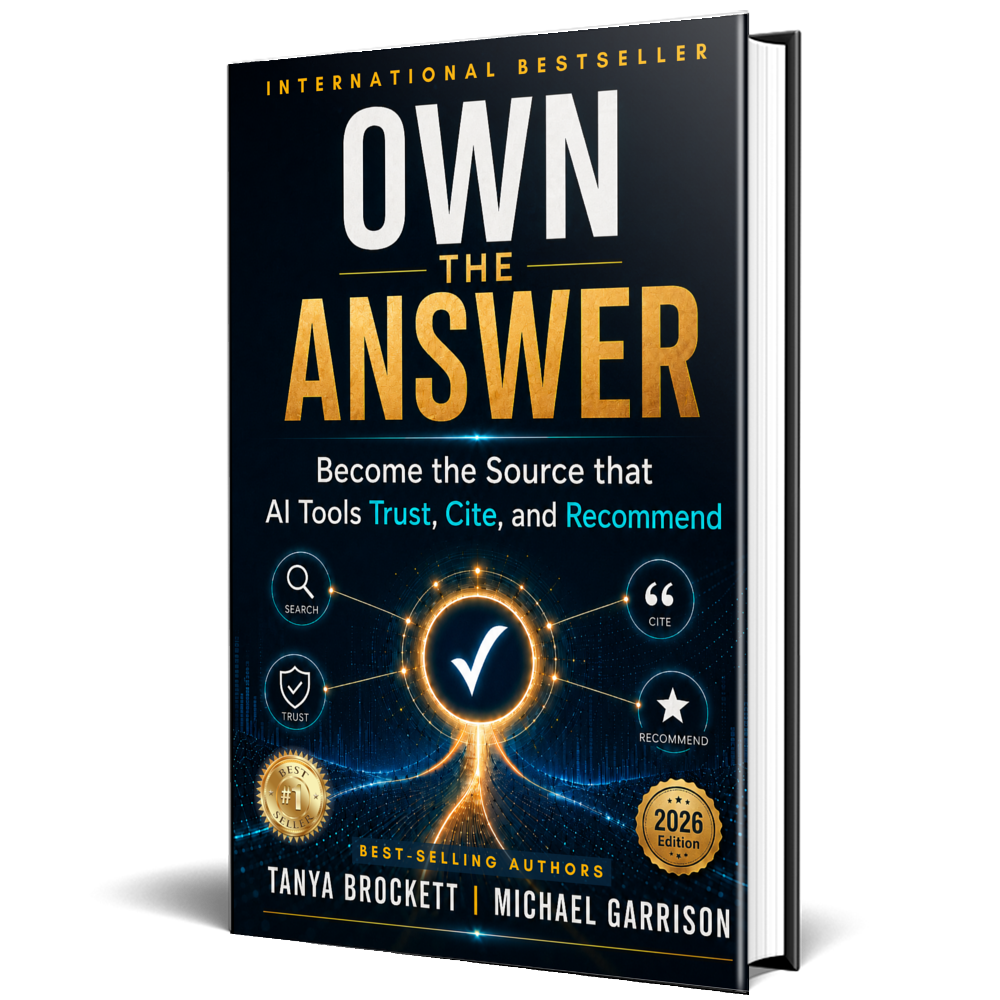
Discover the definitive framework for establishing unshakeable authority in the age of artificial intelligence. Learn how to position your expertise so that algorithms prioritize your insights above the noise.
Read a Sample Chapter
For the last twenty years, the digital marketing playbook was incredibly simple. You ranked number one on Google, captured the click, and drove the customer directly to your website. Business owners, e-commerce entrepreneurs, and corporate leaders poured billions of dollars into traditional search engine tactics with one singular goal in mind. They wanted to own those ten blue links on the first page of search results.
Today, that playbook is completely obsolete.
The way your customers find your business online is fundamentally breaking. If your entire corporate strategy relies on getting users to click a link to visit your website, you are building your business on quicksand. We have officially entered the zero-click era.
Right now, consumer behavior is undergoing a seismic shift. Independent market research indicates that approximately 60% of consumers now use artificial intelligence tools when researching or evaluating a purchase, as detailed by the marketing automation company Klaviyo in their March 2026 report, "AI Persona Research," and corroborated by the University of Virginia Darden School of Business in their June 2025 study, "AI's Influence on Consumer Behavior."
Because of this shift in discovery habits, the traditional search engine is changing. According to extensive clickstream data revealed by market researcher Rand Fishkin in his May 2024 SparkToro article, "New Study: How Much of Google's Search Traffic is Zero-Click?"—conducted in partnership with Datos—nearly 60% of all Google searches in the United States now end without a single click to an external website. This phenomenon is known as the zero-click search. The search click is dying. It is dying fast.
The reason is simple. Search is no longer a direct transaction where a user types a keyword and gets a list of websites. Search has become a conversational, fragmented ecosystem. When a user asks a question today, AI platforms like ChatGPT, Perplexity, and AI Overviews don't just hand the user a list of links to read. Instead, the AI acts as a super-smart assistant. It instantly reads dozens of websites behind the scenes. It synthesizes the information. It types out a direct, custom answer for the user right there on the screen.
Think about standing outside a restaurant and reading the menu posted in the window. You get all the information you need about the food and the prices without ever actually opening the door and walking inside. That is exactly what AI is doing to your website. It is extracting your information and giving it to the customer without ever sending that customer through your digital front door.
This creates two massive crises for business leaders.
When an AI engine uses your content to answer a user's question, but it doesn't provide a link for the user to click, your website traffic drops. You got the impression. The user saw your brand name. You didn't get the click. Marketers call this the dark funnel because tracking it is nearly impossible. Your organic website traffic might be flattening or dropping, even while your actual brand influence is growing rapidly across AI platforms.
AI models don't just rank web pages based on how many keywords are stuffed into the text. They are actively evaluating the factual accuracy and the overall authority of your entire brand. If your website is not viewed by the AI as a primary, trusted source of truth, the AI will simply ignore you. It will recommend your competitors instead.
Most business owners, C-suite executives, and marketers are failing to adapt because they treat these new AI platforms exactly like the traditional search engines of the past. They are confusing outdated terminology. They are using old tactics on new technology.
To survive, stop trying to rank for clicks. Instead, your new goal is to become the definitive, trusted expert that AI engines actively cite and reference. To do this, we need to completely redefine our vocabulary.
To build an AI-proof content strategy, it is essential to master the distinct differences between the three core pillars of online discovery. These are SEO, AEO, and GEO. They sound similar. They serve completely different purposes.
SEO is the traditional practice of formatting your website for search engine algorithms so you can rank higher and drive traffic to your site. It is all about capturing traditional search volume.
Think of SEO as laying the concrete foundation and framing the walls of your physical brick-and-mortar store. If the doors are locked and the lights are off, nobody will go inside. SEO is the technical health of your website. It ensures that search engine bots can easily crawl through your pages, understand what you sell, and index your site properly.
Despite the rise of AI, Google still processes billions of searches every single day. SEO is not dead. It is simply the baseline requirement to exist on the internet. SEO helps you identify exactly where the customer demand is. It provides the foundational visibility your business needs to survive.
AEO is the practice of creating highly structured, easy-to-read content designed to show up as direct answers, featured snippets, and voice search responses. AEO provides fast, immediate visibility for high-intent searches when a customer is ready to buy.
If SEO is building the physical store, AEO is setting up clear, highly visible signs above every single product aisle. Imagine you have a robot clerk working in your store who is responsible for customer assistance with your products. If your product details, prices, and warranties are scattered randomly in a messy pile of text, the robot gets confused. It can't help the customer. However, if you organize your information into clear lists and simple tables, the robot can instantly read the sign and answer the customer's question perfectly.
AI platforms don't read websites like human beings do. They scan for explicit, structured data. AEO requires formatting your content in an answer-first structure. When a customer asks about the best software for accounting, your AEO strategy ensures your website provides a sharp, direct answer that the AI can instantly grab and display to the user.
GEO goes much deeper than AEO. GEO is the practice of producing original, highly authoritative content so that AI models deeply trust your brand. This includes proprietary industry research, expert whitepapers, and data-backed guides. When a large language model generates a complete summary of an industry, GEO ensures it cites your brand as the ultimate source.
If SEO is the building, and AEO is the signage, GEO is your reputation as the mayor of the town. You don't just own a store. You literally wrote the book on the products you sell. Because you are the undisputed expert, every other business, newspaper, and citizen in town naturally recommends you.
GEO is about building lasting authority. You aren't trying to rank for a quick keyword. You are proving to the AI that you are the most trustworthy expert in your entire industry. When an AI model needs to generate an answer about complex topics, it pulls from your content because you have proven your credentials.
The biggest mistake business owners make is thinking they have to choose just one of these strategies. You don't have to choose. In fact, these three strategies are not opposing forces. They are deeply complementary tools that must be used together.
To dominate your market in 2026, executing all three simultaneously is key. Here is exactly how to deploy them across your business.
Maintain your traditional SEO to capture the billions of standard searches still happening every day. Use SEO to ensure your website loads lightning-fast. Make sure it is perfectly formatted for mobile phones and has a logical, clear menu structure. Use traditional keyword research to understand exactly what your customers are looking for. This tells you exactly where the market demand currently lives. Without this technical foundation, the AI bots can't even access your brilliant content.
AEO should be heavily applied to the pages where your customers are making buying decisions. This includes your product pages, service comparisons, pricing pages, and frequently asked questions.
To implement AEO technically, write in an answer-first format. Look at the exact questions your customers are typing into Google. Make those questions the main headers on your webpage. Immediately beneath that header, provide a clear, punchy answer in two to four sentences. Use numbered lists whenever possible.
It is highly recommended to use schema markup. Schema markup is a type of code you put on your website that acts like digital sticky notes for AI robots. These digital sticky notes explicitly tell the AI that specific text is a frequently asked question, or that a specific number is the price of the product. By clearly labeling your data, you make it incredibly easy for answer engines to extract your information and display it to users.
While AEO wins you quick visibility on specific questions, GEO is the long game that builds an impenetrable moat around your business. Apply GEO to your long-form content, industry guides, and company blogs.
To implement GEO, prioritize publishing original, proprietary research that includes real data that nobody else in your industry has. Don't write generic articles that anyone could have copied from Wikipedia. Provide genuine expert insights. Include highly detailed author biographies on your articles to prove that your team has real-world credentials and experience. Cite other reputable sources. Always display a last-updated date on your articles so the AI knows your information is completely fresh and relevant.
Let's look at a concrete example of how this all comes together. Imagine you run a business that sells payroll software to other businesses.
Your SEO strategy ensures that your website ranks well when someone types "payroll software" into Google. It ensures the site loads quickly on an iPhone.
Your AEO strategy involves creating a perfectly structured pricing page. You use numbered lists to clearly compare your software against your biggest competitor. This makes it easy for ChatGPT or other AI to instantly pull your pricing when a user asks how to choose between platforms.
Your GEO strategy involves publishing a massive annual report on the state of employee compensation. Because this report is packed with original data and expert quotes, AI models across the world begin citing your company as the ultimate authority on payroll.
When you combine all three, you create a marketing ecosystem that is completely AI-proof.
To help you and your team transition away from the outdated ten blue links mindset, tracking the right goals is vital. Below is a framework you can use to align your marketing department.
The search click is dying. Your business doesn't have to die with it. The automation of search is here. The transition to AI-driven discovery is accelerating faster than any technological shift in history.
The question is no longer whether your business will adapt to these changes. The only question is whether you will adapt right now, while there is still time to lead your industry, or if you will be left scrambling to catch up after your competitors have already dominated the AI landscape.
Stop chasing clicks. Start building verifiable, machine-readable authority. Master the new lexicon of SEO, AEO, and GEO, and you will secure your brand's visibility for the next decade of digital discovery.
Join the exclusive waitlist to secure your physical copy of the 2026 Edition before the official public release. Be the first to master the new rules of AI authority.
A breakdown of the core frameworks you will discover inside "Own The Answer".
The days of typing three simple words into a search engine are over. Today, customers ask artificial intelligence long, detailed questions to solve their problems. In this section, you will learn the new rules of getting found online. You will also meet the three different "personalities" of AI engines—The Synthesizer, The Researcher, and The Conversationalist. Understanding what each AI is looking for will help your business stop fighting for website clicks and start becoming the trusted answer.
AI doesn't care how pretty your website looks or how creative your writing is; it just wants the facts. Learn how to break down long, rambling web pages into clear, bite-sized pieces of information called "knowledge fragments." You will discover how to organize your content using simple lists, data tables, and special hidden codes. By organizing your information perfectly, you make it incredibly easy for AI robots to read, understand, and recommend your products.
AI machines are designed to find the truth, and they only want to recommend the best experts. Learn how to get other websites and real people talking about your brand across the internet so that AI learns to trust you. You will also learn how to measure the "dark funnel"—this happens when an AI recommends you and causes a sale, but your old tracking software can't see where the buyer came from. Finally, you will learn how to prepare for the near future, where smart AI bots will actually do the shopping and buying for humans.